
60 Degrees Pharmaceuticals Suspends Phase IIB Study of Tafenoquine for COVID-19, Pivots to Refocus on Commercialization of Treatments for Malaria and Tick-Borne Diseases
- FDA advice to Company suggested execution of ACLR8-LR, a placebo-controlled Phase IIB study of tafenoquine in COVID-19 patients, may not be feasible in the
U.S.
- Company will therefore focus efforts on further commercialization related to ARAKODA® (tafenoquine) for prophylaxis of malaria, and prepare for a Phase IIA study of tafenoquine in hospitalized babesiosis patients
- Company is preparing for submission of a pre-IND meeting request with FDA for babesiosis in the current fourth quarter of 2023, and plans to appoint a chief commercial officer to lead ARAKODA commercialization
The FDA has approved or authorized two marketed oral products, Lagrevio™ and Paxlovid™, for use in cases of mild-to-moderate COVID-19 disease to reduce the rate of hospitalizations and deaths in patients with high risk of disease progression. However, the FDA has explicitly not authorized the use of those products in patients with low risk of COVID-19 disease progression. Accordingly, Lagrevio and Paxlovid are not recommended by public health agencies for that purpose.
Current literature on COVID-19 shows that low risk patients have a very low risk of hospitalization. However, patients may wish to make a risk-based decision together with their physician to use a therapeutic that accelerates clinical recovery from COVID-19 symptoms if such a therapeutic were available. FDA guidance for industry implies that a regulatory pathway does exist for approval of new therapeutics that produce “sustained clinical recovery” in COVID-19 patients. FDA-approved or authorized oral therapies have either failed or have not been studied against that endpoint.
60P’s early, published Phase IIA clinical data suggested the possibility of a 2 – 2.5 day improvement in clinical recovery from cough, fever, and shortness of breath.1 Simulations of data from the same study suggested this might also be the case for the FDA’s preferred endpoint of “sustained clinical recovery” from all acute symptoms excluding impaired taste and smell (see accompanying figure).
However, in a recent IND withdrawal acknowledgement letter from the FDA, the agency implied that a placebo-controlled study in the
As a practical matter, the population of patients in the
Accordingly, as outlined in its registration statement and subsequent communications to the investment community, 60P will instead continue to prepare to conduct a Phase IIA study of tafenoquine in hospitalized babesiosis patients, with the goal of requesting a pre-IND meeting with FDA before the end of 2023.
An estimated 47,000 cases of babesiosis (infections caused by red blood cell parasites similar to malaria that are transmitted by deer tick bites) occur in the United States each year, and the incidence rate is increasing. Estimates are that 10 percent of Lyme disease patients are co-infected with babesiosis. Post-exposure prophylaxis following a tick bite is a recognized indication to prevent Lyme disease, and it is likely that a drug proven to be effective for this indication for babesiosis would also be used in conjunction with Lyme prophylaxis.
60P also intends to hire a commercial operations executive to expand its commercialization efforts related to ARAKODA (tafenoquine), an antimalarial indicated for prophylaxis of malaria in patients 18 years and older and approved by the FDA in 2018. In the second quarter of 2023, sales of ARAKODA increased by 150 percent relative to the same period in 2022, at an accelerating growth rate.
About ARAKODA® (tafenoquine)
Tafenoquine was discovered by
ARAKODA® (tafenoquine) Important Safety Information
ARAKODA® is an antimalarial indicated for the prophylaxis of malaria in patients aged 18 years of age and older.
Contraindications
ARAKODA® should not be administered to:
- Glucose-6-phosphate dehydrogenase (“G6PD”) deficiency or unknown G6PD status;
- Breastfeeding by a lactating woman when the infant is found to be G6PD deficient or if G6PD status is unknown;
- Patients with a history of psychotic disorders or current psychotic symptoms; or
- Known hypersensitivity reactions to tafenoquine, other 8-aminoquinolines, or any component of ARAKODA®.
Warnings and Precautions
Hemolytic Anemia: G6PD testing must be performed before prescribing ARAKODA® due to the risk of hemolytic anemia. Monitor patients for signs or symptoms of hemolysis.
G6PD Deficiency in Pregnancy or Lactation: ARAKODA® may cause fetal harm when administered to a pregnant woman with a G6PD-deficient fetus. ARAKODA® is not recommended during pregnancy. A G6PD-deficient infant may be at risk for hemolytic anemia from exposure to ARAKODA® through breast milk. Check infant’s G6PD status before breastfeeding begins.
Methemoglobinemia: Asymptomatic elevations in blood methemoglobin have been observed. Initiate appropriate therapy if signs or symptoms of methemoglobinemia occur.
Psychiatric Effects: Serious psychotic adverse reactions have been observed in patients with a history of psychosis or schizophrenia, at doses different from the approved dose. If psychotic symptoms (hallucinations, delusions, or grossly disorganized thinking or behavior) occur, consider discontinuation of ARAKODA® therapy and evaluation by a mental health professional as soon as possible.
Hypersensitivity Reactions: Serious hypersensitivity reactions have been observed with administration of ARAKODA®. If hypersensitivity reactions occur, institute appropriate therapy.
Delayed Adverse Reactions: Due to the long half-life of ARAKODA® (approximately 17 days), psychiatric effects, hemolytic anemia, methemoglobinemia, and hypersensitivity reactions may be delayed in onset and/or duration.
Adverse Reactions: The most common adverse reactions (incidence greater than or equal to 1 percent) were: headache, dizziness, back pain, diarrhea, nausea, vomiting, increased alanine aminotransferase (ALT), motion sickness, insomnia, depression, abnormal dreams, and anxiety.
Drug Interactions
Avoid co-administration with drugs that are substrates of organic cation transporter-2 (OCT2) or multidrug and toxin extrusion (MATE) transporters.
Use in Specific Populations
Lactation: Advise women not to breastfeed a G6PD-deficient infant or infant with unknown G6PD status during treatment and for 3 months after the last dose of ARAKODA®.
To report SUSPECTED ADVERSE REACTIONS, contact 60
About 60
60
Cautionary Note Regarding Forward-Looking Statements
This press release may contain “forward-looking statements” within the meaning of the safe harbor provisions of the
Reference:
G. Dow ,B. Smith , A phase II, double blind, placebo-controlled, randomized evaluation of the safety and efficacy of tafenoquine in patients with mild-moderate COVID-19 disease. New Microbes and New Infections,Vols . 1 to 55; 2013 to 2023. Published online 2022Jun 1 .
Media Contact:
SheilaBurke-consultant@60degreespharma.com
(484) 667-6330
Investor Contact:
patrickgaynes@60degreespharma.com
(310) 989-5666
A photo accompanying this announcement is available at https://www.globenewswire.com/NewsRoom/AttachmentNg/57ef5cc3-2cf8-4a1b-a9d5-eb3a8747459a


TTCR Improvement Tafenoquine v Placebo
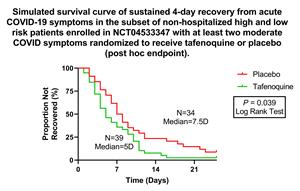
Simulated survival curve of sustained 4-day recovery from acute COVID-19 symptoms in the subset of non-hospitalized high and low risk patients enrolled in NCT04533347 with at least two moderate COVID symptoms randomized to receive tafenoquine or placebo (post hoc endpoint).
Source: Sixty Degrees Pharmaceuticals